

As a brand, the Democratic Party as an institution has done little to nothing to redefine itself. The challenges, of course, go deeper than just how they position themselves publicly. You need a quality “product” or, in the case of politics, a quality set of ideas and vision upon which to build a brand.
A number of high-profile individual Democratic leaders have already begun a de facto rebrand by publicly admitting and addressing the negatives on people’s minds. Star candidates like James Talarico and Jon Ossoff have challenged the bitter parts of the party. There’s no better way to begin the rebrand than admit the mistakes and fix them. Trust is the most vital commodity.
Vision + Policy Priorities for the Future
The starting point for any new strategic plan are values.
The values of the Democratic Party — economic fairness, diversity, and freedom — don’t need to change. The emphasis does. Of the three, freedom is the one most underused. That’s where the reemphasis needs to be.
Everyone already knows the party believes in diversity. That’s probably the only thing the country is crystal clear on.
That’s not enough. It doesn’t meet the moment for most of the country, which is struggling financially.
Everyone should have a realistic chance again to pursue the American Dream and their pursuit of happiness. It speaks to financial success and freedom to live their lives as each person sees fit, without penalty or peril.
Democrats are putting the economy top of mind, and it’s obviously working given the victories on Election Night. They’re beating the drum hard to amplify Trump’s high gas and grocery prices and exorbitant tariffs.
But freedom is less discussed. When it is, it’s framed as “rights” — a relic of the 1960s/70s. “Freedom,” instead, speaks to more people and gets to the heart of the nation’s values. The vast majority of Americans, like our ancestors 250 years ago under British monarchy, again yearn for liberty and the pursuit of happiness. Today, we’re bumping up against elements of tyranny and extreme corruption coming out of our own government.
To animate Democrats’ values, they need some sort of charter or vision document — call it what you will — but a compass for the next decade.
And they need to broadly speak in one voice. That’s not optional. I say this not for kumbaya reasons at all but for strategic ones. Public feuds within the party only help the conservative movement. The divisions between moderates and progressives are real and understandable but no one is going to agree even within their own family with everything. The massive majority of Democrats, and the country, outside of the beltway in the realworld don’t think like this or care that much. There’s something bigger than the internal party divisions: it’s called winning the 2028 presidential campaign.
Make people like Democrats again. Yes, people need to like you all to win a presidential race. I discuss later how to do this but one way is to stop trying to be right all the time—the root of party divisions. Just win. That’s the job of both progressive base and the center left.
A Two-Pager Sketch
The Democratic Party’s 2024 platform was 92 pages with 9 chapters and 26,000 words. By comparison, a much bigger project — the U.S. Constitution — was a mere 7,500 words. The party poo-bahs turned it into an accomplishments document for the Joe Biden Administration — self-serving to one man.
Party platforms are throw-away efforts, for the most part. On the left at least, it has become an inclusive ideas dump of 100 priorities from 1,000 interest groups. You end up with nothing that’s clear and nothing that’s a priority but at least the people involved feel better the process was inclusive.
Feeling good or modeling inclusivity is fine but that's not why we're all here to do politics.
Some sort of long-term directional document is vitally important, not just as a messaging tool but as guide for any mission-driven enterprise. The point is to achieve the policy goals a party sets out to achieve. Deliver for the people, make good on your promises.
What I’m proposing here for the Democrats is a roadmap of new ideas for the 21st century that speak to Gen X down through Gen Z. Middle-age and young vibes.
Serious leaders in the progressive and left-of-center wings need to, at least, take the reins and say here’s where we’re going. Sometimes centralized leadership is required, and it works.
A simple two-page memo — that’s it — is what I’m talking about. Every elected official across the country must do and say what’s best for their state and race. But building a renewed party requires speaking in unison on one major narrative that connects with the largest number of people.
There are four policy buckets in this two-page architecture.
The Economy
Focus on growing wages and quality of jobs (and re-skilling for AI). Bring down the cost of food and bills to be manageable again. Health care costs, which the Dems are already strong on, should be part of this. I saw a simple proposal from the Searchlight Institute that calls for:
(1) Making primary care free for all Americans, regardless of coverage source. (2) Creating a nonprofit public option, the American Health Gateway, to be available to all Americans in need.
AI Guardrails
Policy needs to speed up quickly on AI governance. I’ll let the policy people work out the details on this one, but the gist is to prevent the bad impacts and boost the good, like innovation. The public is on board with responsible regulation that doesn’t stifle innovation. Cramming AI — data centers, the ability to mass produce misinformation, and so on — down our throats is the problem. The public needs to have some say and control. We know Silicon Valley doesn’t want any public debate.
AI data centers are everything wrapped up in a bow for Democrats: higher costs, dirty water, hazing-level noises, and a tyrannical process of building these things. You don’t have to oppose AI or the warehouse itself. It’s all of the other problems.
A 21st century civil rights movement
This is where “freedom” as message and “rights” as policy connect: the framing up front should lead with freedom, but the substance underneath is still a civil rights agenda.
The party still has to live up to its long-held value of equality. The old-but-always necessary civil rights movement needs a new roar. The goals are ending gerrymandering and restoring Black voting rights, which the Supreme Court essentially rescinded in 2013 and again in 2026.
Democrats continuing — doubling down on — its decades-long push on civil rights has to deliver results. At times, there’s been lip service, but Democratic presidents and members of Congress have without question delivered over time.
Part of the new equality movement, looking toward 2050 not 1950, should probably also take into account the odd fringe effort to keep rolling back women’s rights, including the right to vote. (Remember: the policies that once sounded absurd have become realities.)
Operating system flaw
Constitutional scholars and political scientists have been busy over the past 18 months diagnosing how someone like Trump slipped through the cracks. From the New York Times:
The framers believed that the threat of impeachment and removal would be a decisive check on the president... But they failed to anticipate a development that would make impeachment improbable: the rise of political parties.
...the founding generation may have been unduly optimistic about the power of norms and expectations, grounded in part in Washington’s sterling character. “I do think that they expected that the president would be bound by a sense of duty to the law and to the Constitution,” Professor McConnell said.
I don’t see how the only opposition party in America can ignore this and other autocratic loopholes to prevent it from happening again. Democrats should own this diagnosis with actual fixes — legislative proposals to strengthen independent oversight of the executive, close self-pardon and emergency-powers loopholes, and restore teeth to congressional subpoena enforcement — rather than only describing the problem. Supreme Court reform --18—year term limits versus their current lifetime appointments--should be on the table.
What this isn’t
The left’s Project 2029 effort that’s underway — stemming from the right’s 900-page dream document called Project 2025 — is premature, actually. I say focus all of that time on four policy buckets. Have the magnum opus ready but under wraps if Democrats win presidency in 2028.
To be clear, however, a widely promoted roadmap — whatever that looks like — is needed yesterday. People want leadership and direction. Now. The two-page memo is that near-term roadmap; the 900-page book is the follow-on once the party actually holds power to execute it.
Having a policy plan that reflects the general public’s priorities isn’t of course enough. Voters need to like Democrats. The likability factor is woefully underrated by many progressives (though AOC is showing us how you can be all about policy and have people like you.) The brand — how people feel— is as important — and yes as important —as values and policy. Which leads me to the whiff of elitism.
Elephant in the Room
Some elites sometimes think their shit don’t stink — they’re the smartest people in the room. But that ethos has come back to bite them in politics.
The far right has long enjoyed branding the left as out of touch and elitist. Just because they said it doesn’t mean it’s not true. I say that from what everyday people, including rank-and-file Democrats, have told pollsters.
The coastal elites sometimes get in their own way. I think they downplay, ignore, are oblivious to, or just don’t care about how their stature--education, money, social standing– can be a hidden drag on achieving the civic outcomes they want.
Jared Abbott and colleague argue the way into the democracy conversation with working class voters is through economics: cost of living and stagnant wages. Listen to and solve the financial anxiety, then sustaining democracy is a more viable option.
The author makes another point about liberal intellectuals being judgmental and looking down on others, whether real or perceived. The “latte liberal” ethos is also highlighted by philanthropist Rachel Pritzker in the Chronicle of Philanthropy. Well-off liberals who fund and run the democracy movement must get out of their bubbles and authentically reach the working class voters, if they want to win.
“Our values and priorities are out of step with a wide swath of the country,” Pritzker wrote.
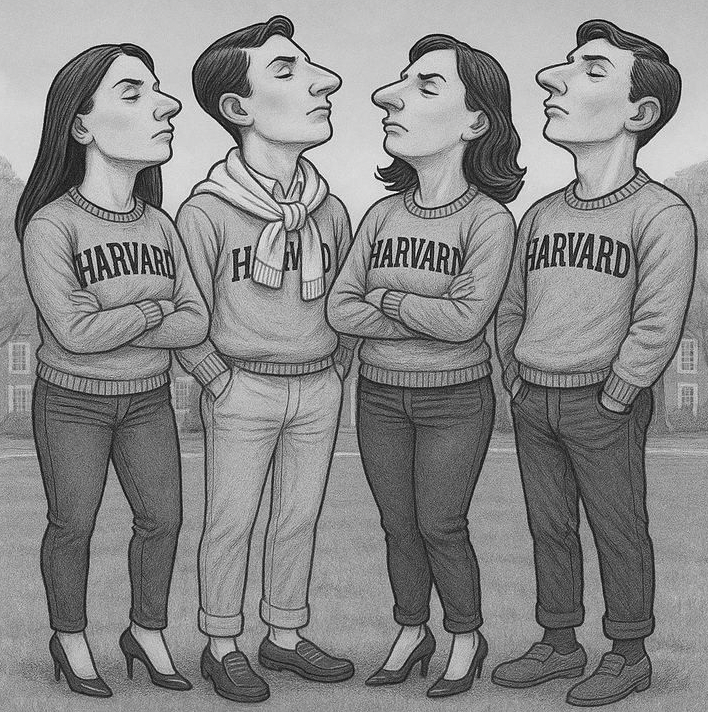
If the intellectual Democrats really want to be the smartest people in the room, they would recognize their small, upper-crusted place in society and control for it in their work.